Pick a selection. The whole manuscript, seven records, front to back. Story, rules, laws, method, cast, voices, and the build order.
Make a selection
Now playing · A1 · THE FILM: THE CAROLINAS
THE FILM: THE CAROLINAS
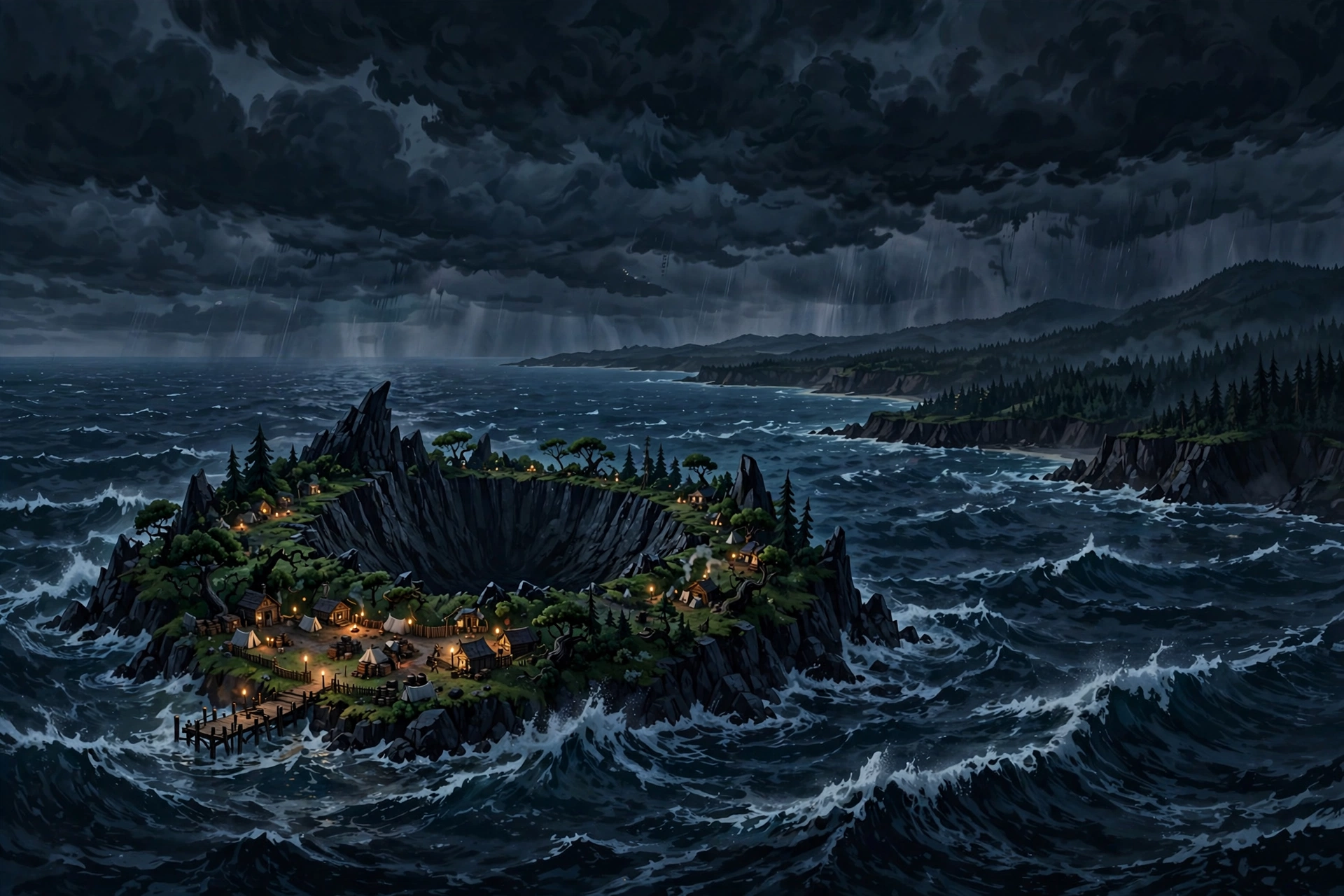
A feature horror film. 1800. Two miles off the South Carolina coast sits an island that does not appear on any honest map. The people there did not wash up by accident. They looked at New York harbor and Jamestown and said no: Mormons with jaw-set certainty, Protestants who pray like they're arguing, Catholics who cross themselves at thunder, plain miscreants, thieves, runaways, half-feral roughnecks. Holy people and unholy people who agreed on exactly one thing: the mainland was not for them.
The island pays them for the choice. Sand crabs crowd the shallows. Lobsters the size of a man's forearm wait in the rocks. Food hangs off trees and washes up on the beach. Wood for fire and building, more than they can burn in ten lifetimes. Tobacco soil, dark and sweet. They want for nothing. That is exactly why they stay.
In the middle of the island there is a valley like a belly button. It used to be a volcano. The walls drop steep and jagged, black rock teeth, air coming up smelling of old fire and wet stone. Anyone who goes down there usually doesn't come back. The island's one ritual is the descent: when the colony needs something from the deep, someone has to go into the valley. It is an honor and a sentence and everybody understands it is both.
The churches are small and everywhere, little white boxes with crooked steeples, their bells arguing on Sundays. Superstition hangs over the island like heat. There are no natives here, none. Just white settlers and the Africans they brought with them, taken from across the sea to work the tobacco and carry the wood.
For two years they have drunk from the seep at the valley's edge, a thin bright trickle out of the rock. Now the water is going deeper, sinking into the throat of the hole like the island is swallowing. Someone has to follow it. There is only one person small enough to fit through the fissure: a little girl. Ruth. Nine years old, all elbows and knees.
They lower her on a rope at dawn, the whole island watching, her mother Martha holding the rope, the priest Father Hale reading over the edge. The lantern at her ankle gets smaller until it is a star, until it is nothing. She doesn't come back. That is the rule of the valley. That's when the movie starts.
Two days later a fisherman finds her on the beach, sitting in the surf. She looks up at Martha with eyes that have seen the bottom of something and says it plain: "I found the water. I came out the other side." Then she dies, right there in her mother's arms, in front of half the island. One breath, and she is gone.
Father Hale does everything the book tells him. He prays, anoints, lays hands on her cold forehead, commands. Nothing happens. So they go and get Kwame, taken from Africa years ago, the invisible man of the Carolinas. They put a real pistol to his head and tell him: heal her. Use your voodoo. Use your African powers. Bring her back or we put you in the ground next to her.
The church is full and nobody is breathing. Martha kneels beside the bench, gripping the sides of her daughter's face, bent over her, mouth almost touching the girl's forehead, chanting: "You're going to live. You're going to live. You're going to live." Kwame kneels on the other side, the gun still on him, and does the only thing he knows: he talks to the girl. Plain. Urgent. Human. "Come on, bro. You got this. Come on, man. Wake up. Hey. Hey, how you doing? Wake up, now. Come on."
But to white ears in 1800, an African man speaking urgent and rhythmic over a dead child does not sound like encouragement. It sounds like a different language. An incantation. Voodoo. Every "wake up, bro" lands as witchcraft, because witchcraft is what they need it to be. If it is witchcraft, it can be controlled. If it is witchcraft, it belongs to them now.
Three minutes pass. Five. The gun shakes. Ruth opens her eyes. The church detonates: screaming, weeping, hugging, hysteria. In the middle of it Kwame backs up, kneels, tries to become invisible, folds himself smaller and smaller, shoulders in, head down, like a monk, like a turtle pulling into its shell. He doesn't know where to go and there is nowhere to go.
They won't let him be small. They peel him off the ground with their congratulations, lift him, throw him in the air and carry him like those paintings of Christ being carried to the cross. It looks like worship. It looks like a sacrifice. Because it is one.
Afterward the men sit with the question: he brought her back, who's in charge now? Someone says we should kill him. Someone else says the thing that damns them: we can't kill him. In case we need him. So they keep him. A hut better than any on the island, fed from their tables, guarded day and night for his protection, they say. When the fever takes the Miller baby and Kwame talks it back, it settles: he is their life-giving ornament. Their miracle, polished and mounted and owned. He never asked for any of it.
Here is where their mercy curdles. Ruth was the first one back through the door. She found the water on the other side. Nobody asked what the other side was. The baby Kwame raised doesn't cry right; it watches, with Ruth's eyes, the eyes that saw the bottom of something. Old man Tiller dies, they beg Kwame, Tiller comes back wrong too, wrong in a way nobody can name but everybody feels, like a song played one note off. Every life Kwame gives back comes back through the same door Ruth found, and something comes through with them. A little more each time. The island fills slowly with the returned. And the returned are patient.
The end comes the way it always was going to. The colony decides they have to kill him after all. Too late. They go to the hut with ropes and torches, and the returned are standing in the lane. Ruth in front, nine years old, smiling like a child. The baby in someone's arms, watching. Tiller. The others. Kwame kneels in the middle of them, small as a turtle, looks up at the torches, and says the only thing he knows how to say. "Come on, bro. Wake up."
Dawn. Two miles off the coast. The island sits low and green in the haze. Still not on any honest map. Nothing that happens there ever leaves. But the water keeps running deeper. And somebody always has to go into the valley.
Now playing · A2 · THE CAROLINAS RULES
THE CAROLINAS RULES
1. THE VALLEY RULE: the valley is a dead volcano throat in the island's middle. Anyone who goes down usually doesn't come back. The descent is the island's sacrament: an honor and a sentence, everybody watching. 2. THE MISHEARING RULE: Kwame's words are never magic on the page. He speaks plain encouragement. The settlers HEAR witchcraft because of who he is. The horror is their mishearing, never his power. Never write him casting a spell. 3. THE RETURN RULE: everyone Kwame brings back comes back through the door Ruth found, on the other side of the water, and something comes back with them. The returned are patient and wrong in unnameable ways. Dread, not gore. 4. THE ORNAMENT RULE: the colony's worship reads as sacrifice. They carry him like Christ to the cross. Every kindness they show him is ownership. 5. THE WITHHOLD RULE: never pre-explain the horror. The audience is never told what the camera has not shown. Let dread build the thing in their heads; when the reveal lands it must recontextualize everything before it.
Now playing · B1 · THE TWELVE PRODUCTION LAWS
THE TWELVE PRODUCTION LAWS
1. ONE BEAT, ONE TELLING. Every story beat appears on screen exactly once. If the same action, line, or story information appears twice in the cut, that is a defect. Name each scene's single beat; no two scenes share one. 2. THE SCREENPLAY IS THE EDIT. Every scene maps to the screenplay in screenplay order, each played once. Dialogue is the screenplay's dialogue word for word, said by the scripted character. No line in two scenes. No scripted beat, no ship. 3. VOICES ARE CAST, NOT ROLLED. Before any dialogue prompt: every speaking character gets ONE fixed voice, no two characters share a voice, the voice matches the face in gender and age. Voice consistency is verified by listening, never by metadata. A voice that changes or mismatches is a defect. 4. DIRECT THE BLOCKING. Every prompt states what each body does, how they move through space, what they touch, how they pass obstacles. Impossible action (walking through a solid object) is an automatic FAIL. Prompts direct action, not pictures. 5. WATCH THE MOVIE. No cut is verified until the full assembly is watched in order, eyes on: story progresses, no beat repeats, voices hold, faces match voices, action possible, continuity holds. File/decode/hash/silent-timestamp checks alone are banned as pass criteria. "Verified" means someone watched the movie. 6. SCENES CARRY WEIGHT. Build to scripted weight. Major dramatic scenes run 45 to 90 seconds or longer, from real coverage: wides, mediums, close-ups, inserts. One line never becomes eight ten-second scenes. Padding (loops, repeats, slow motion, empty staring) is banned. 7. THE WORLD PERSISTS. Wardrobe, hair, injuries, props, world state persist across scenes unless the screenplay changes them. Check each scene's first kept clip against the previous scene's last. 8. CREDITS ARE REAL MONEY. No clip is kept unless it tells a unique scripted beat no kept clip already tells. Alternates are cheap to generate and expensive to keep. 9. THE VIEWER DOES NOT KNOW UNTIL THEY SEE. Withhold the reveal. Never pre-explain the monster, the threat, or the truth. The gap between what the viewer builds in their head and what the camera finally shows is where the movie lives. 10. EVERY FILM OWNS ITS SOUND FAMILY. (Pipeline note: the Carolinas gets its own homogeneous family of sound beds/motifs, built and auditioned for this film only, never borrowed from another film's family.) 11. NO STUDIO LAURELS. Banned: children as sympathy props, sick kids as props, kids sitting silent at tables for easy tears. Horror comes from the scare, never from pointing the camera at a fragile child. NOTE FOR THIS FILM: Ruth is not a laurel. She is the engine: she acts, she chooses, she descends, she speaks, she returns, she leads. Write her as a true character with agency, never as something the camera pities. 12. THE BLACKFISH LAW. Ship the story or lose it. Development hell is forfeit; the window closes whether you are ready or not.
Now playing · B2 · THE METHOD
THE METHOD
1. TEXT TO VIDEO ONLY. The generator takes a written prompt and returns a video clip. It has no memory: every clip is generated fresh, knowing nothing about the others. Every prompt must be fully self-contained. 2. SIX-BLOCK PROMPT ARCHITECTURE. Every generation prompt you write contains all six blocks, in this order: (1) SCENE + BEAT: the screenplay scene and beat plus written confirmation that no kept clip already tells it. (2) CAST: every character on screen, with locked voice IDs for dialogue. (3) BLOCKING: physical action, bodies in space, how obstacles are passed. (4) DIALOGUE: exact screenplay lines, each attributed to its scripted speaker; no invented or paraphrased lines. (5) CONTINUITY: wardrobe, hair, props, injuries, world state as established. (6) CAMERA: shot size and movement, in service of the beat. 3. CHARACTER CONSISTENCY. The pipeline inserts each immutable character block below verbatim into every prompt for that character. You do NOT reword them, ever; rewording breaks convergence. You only direct what they DO. 4. VOICE LOCK. Every dialogue scene carries the character's locked voice: exactly one speaker, the exact line, spoken once, mouth moving only for that line. No second voices, no crowd chatter, no overlap. Dialogue at full natural level, never whisper-quiet. 5. VISUAL STYLE. Animated cinematic style, cartoon, never photorealistic people. This is a standing studio rule: our characters are drawn, not imitated. 6. TECHNICAL HARD RULES. Landscape 16:9 only, never portrait. Every scene ends cleanly on the last scripted line or action; no trailing sigh, no held stare into nothing. Two-person dialogue staged as singles where it serves the beat. No heavy readable on-screen text. No sexualization, ever, especially of the child. 7. QA. Every kept clip is watched by a human. A clip FAILS on any of: identity drift; impossible blocking; objects or props appearing/disappearing mid-clip; a repeated beat; voice mismatching the face or changing; wrong, missing, or duplicated dialogue; whisper-level dialogue; invented logos, patches, or lettering. Write every prompt to avoid all of these.
Now playing · C1 · CHARACTER BLOCKS
CHARACTER BLOCKS
RUTH: Ruth is a 9-year-old girl, animated cartoon style, all elbows and knees, small enough to fold herself through a crack in the world. Big watchful dark eyes that have seen the bottom of something. Tangled dark hair, a plain homespun dress, bare feet. She is never cute for the camera and never a sympathy prop; she acts, she chooses, she speaks plain.
MARTHA: Martha is Ruth's mother, animated cartoon style, a worn woman in her 30s with a fierce, frayed tenderness. Lined face, hair pulled back hard, work dress and apron. When she holds her daughter's face, the whole island holds its breath.
KWAME: Kwame is an African man in his 30s, animated cartoon style, taken from Africa years ago, the labor of the tobacco rows in his shoulders. Deep-set gentle eyes, close-cut hair, plain work clothes. He carries himself small, shoulders in, head down, like a man trying to become invisible, like a turtle pulling into its shell. Quiet dignity. Never a caricature, never a mystic. He is an ordinary man whom frightened people decided was a god.
FATHER HALE: Father Hale is a thin aging priest, animated cartoon style, reedy and prayer-worn, his certainty cracking at the edges. Black coat gone gray at the seams, a wooden cross. His prayers fail on screen, and he knows it.
SETTLERS: The colony of the Carolinas, animated cartoon style: Mormon elders with jaw-set certainty, a Protestant preacher who prays like he's arguing, Catholic fishermen who cross themselves at thunder, plain miscreants and runaways, half-feral roughnecks. 1800 frontier dress, weathered, armed. A crowd that can turn from churchgoers to a torch mob without changing clothes.
Now playing · C2 · VOICE CASTING
VOICE CASTING
RUTH: a real child's voice, plain and flat, eerie in its plainness. She reports impossible things like chores. Never cutesy, never performed. MARTHA: raw maternal, frayed at the edges. A chant more than a speech when she begs. KWAME: deep, warm, unhurried, plain-spoken. He talks a dying girl back the way you'd talk anyone back: "come on, bro, wake up." No caricature, no mystic cadence. The ordinariness is the point. FATHER HALE: thin, reedy, prayerful, cracking under the weight of a silent heaven. SETTLERS: a rough frontier murmur for crowds; individual settler lines get individual plain voices, never shared with the four principals.
Now playing · D1 · WHAT YOU DELIVER, IN ORDER
WHAT YOU DELIVER, IN ORDER
PART 1, THE SCREENPLAY: expand the story into numbered scenes in exact film order (CAR-1, CAR-2, ...). As many scenes as the story needs; every scene carries real weight (major dramatic scenes 45-90 seconds or longer in coverage). Each scene line reads: CODE | BEAT (one sentence, unique) | ACTION | DIALOGUE (exact lines, attributed) | WRONG (the one wrong detail, if any). No beat repeats. No line repeats. Read the whole story before writing anything.
PART 2, THE GENERATION PROMPTS: one complete six-block prompt per screenplay scene, in the same order, scene IDs printed exactly. Deliver them in labeled batches (BATCH 1, BATCH 2, ...) so they can be run in groups.
HARD RULES FOR YOUR OUTPUT: zero prior knowledge; do not reword the character blocks; do not share voices; do not repeat beats or lines; do not pre-explain the horror (Law 9); do not write Kwame performing magic (the Mishearing Rule); Ruth is a character, never a prop (Law 11); every prompt self-contained, because the generator has no memory.
PIPELINE NOTES (for after generation, not your output): kept clips pass the per-clip keep checklist (watched in motion, PASS/FAIL with defect named, voice matches face, blocking possible, beat untold, continuity holds). Review batches are zips of actual MP4s plus a CSV manifest (scene id, expected dialogue line, blank verdict field). Nothing is called verified without a full eyes-on watch of the assembly in order. Finished films are archived forever, never deleted.